Monday, January 27, 2014

"Brothers" Process

The two elements I was interested in most in developing this piece were texture and symmetry. Ordinarily, many painters tend to prefer an asymmetrical composition. And rightly so, as it creates more visual interest, less redundancy, and there's something intuitively pleasing to the eye about a little bit of lop-sidedness. That being said, there are many examples of symmetrical masterpieces in our long history, so I didn't want to close off that possibility. It's particularly important that symmetry, as with my earlier piece "Duel", tends to highlight the subtle and inevitable differences one can pick out looking from one side to the other. It focuses the eye, in other words. It also brings to my mind nearly iconic, perhaps spiritual or mythic qualities, simply by virtue of such a strong presence of pattern and rhythm in the context of a natural scene. I wanted a piece that was at once realistic and yet felt orchestrated in the way a religious tableau would be orchestrated. Texture was also a way for me to create visual interest in a way that pulled the eye away from the realism of the scene and out to the surface of the paint while at the same time suggesting an even greater realism in its palpability. That's a bit of an academic way of saying I just like the rough and worn look.

Anyway, without further ado, here's my set up:


I've customized my easel a bit so that I wouldn't have to keep reaching for my weapons of choice, these preferred brushes and the paper towel roll to wipe them with.  I figured I could either shell out the big bucks for another easel just like mine that happened to have the cups and the roll attached, or I could just use what I had around the house to fashion my own.  I bought a hole saw and attached it to my power drill, found some thin craft wood boards and cut holes that were just about the same size as the mouths of these mason jars.  I then screwed the mason jars onto the boards and then bolted the board/jar combo to the easel.  Voila.  The towel roll holder is the standard kind you often find installed under kitchen cabinets.  I just bolted a board onto the easel and then bolted the roll holder onto that.  

At this point, I've primed my canvas and I've got enough thumbnail sketches drawn out to know exactly how I want to begin.  That's the key, after all:  knowing thoroughly how to begin while leaving the ending up to chance.  The image I had in mind was of two bulls locking horns.  Again, while it might have been much more eye-catching to depict them at a dynamic angle, I chose to paint them straight on, showing their profiles equally, creating a symmetrical arc.


At this point, I've roughed in all the major compositional elements I need.  I can now comfortably switch gears and think about texture.  Here are just a few of the tools, beside the usual brushes and palette knives, at my disposal:


All of these -- sponges, steel wool, various combs, sandpaper, solvent -- can create all sorts of interesting textures.  I began by laying down swaths of color, incompletely mixed, with a large brush and a palette knife.  Once the area was covered, I went back in with thicker paint, straight out of the tube without medium, and broke it up with the above tools.


The paint is still rather wet in this photo so the texture doesn't show very well.  But it definitely reads when you look at the real thing.  

Now, back to the bulls.


And, again, some foreground texture.


At this point, I had to put it up for a while and give some thought about how to handle the home stretch.  This is the ending left to change I was talking about before.  Too often, I find myself wanting to rush to the end and I end up over-painting the thing or painting it to death, as they say.  So I've made a habit of stopping just short of being "finished" and letting it sit out of view for a while so that I may revisit it with fresher, more objective eyes later.  This one took about a month out of view before I went back to it.  I ended up changing the color dynamics a bit, adding more grays, greens, and yellows to the background and varying the hues in the hides of the bulls a bit more.  I'm out of time right now but I'll take a photo soon and post the most recent incarnation of this painting soon!


Thursday, January 16, 2014

"Duel": Process

Here's another set of photos of another painting process I posted a couple of years back. New demonstrations to come shortly!


Wednesday, January 15, 2014

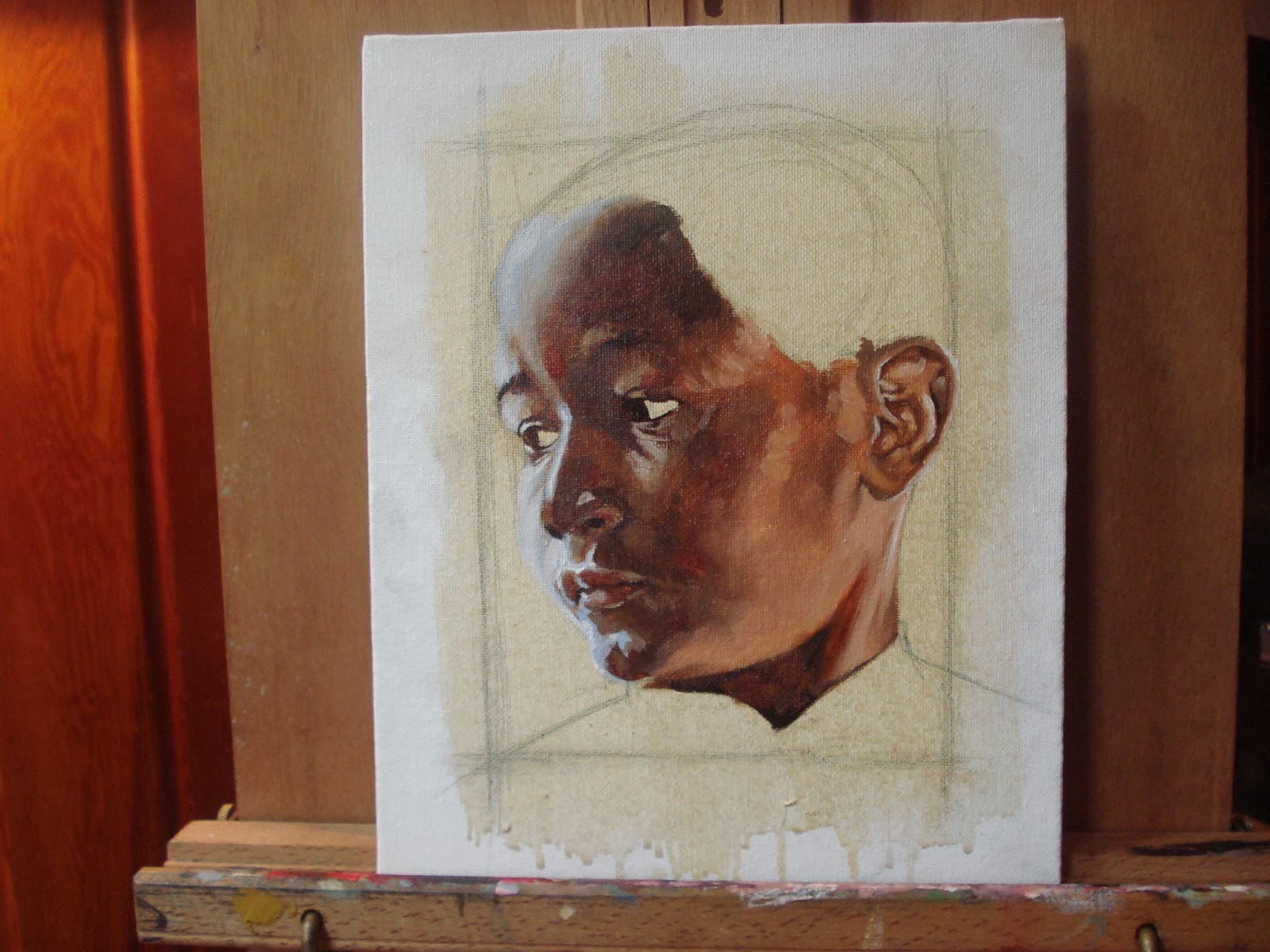
"Boy": Process

I posted these step-by-step photos of the progress of one of my favorite paintings earlier on a different blog that, unfortunately, is no longer with us. But, by popular demand, I've decided to re-post the photos here so that you can get a general sense of how I prefer to approach portrait paintings. Each painting is unique both in style and process so I can't say this is indicative of how I do all my work but there are touchstones: the drawing, blocking in darkest shapes, filling in basic values with a minimal palette and a large brush, then working my way down to the smaller strokes, value shifts, and heightening color in key areas.  


Sunday, October 20, 2013

Studio Update

I've temporarily relocated the studio to the garage which is less than ideal but the great benefit of it is the tall ceiling.  I'm now able to work on the bigger pieces I've been meaning to, and I've got more space in which to set up everything I need to work.  In the long term, I'll have something a bit more permanent installed, which I'll be posting on as we go along.   
This piece which I've tentatively entitled "Mother" has been a freeing experience so far.  I used the biggest brushes I could find and after slathering the painting in Mixed White, I worked into it with a straight Burnt Sienna.  I'm not terribly concerned with color or even value at this point.  Hardly any of these marks will survive under the layers that will go over it.  But the goal was to establish early a sense of sweep and liveliness in the painting, as well as to mark the obvious areas of light and dark.


When first attempting to paint, what I found most comforting was the idea that there's little difference between the various media within the two-dimensional realm.  Whether you're working with a pen, crowquil, ink brush, watercolor, gouache, acrylic or oil, you're essentially applying the same techniques of mark-making on a flat surface.  All of the principles of composition, value, balance and rhythm apply.  I find this comforting because there are times when I feel the urge to get everything right in the preliminary sketch so that I don't end up regretting anything later into the painting stage.  I remind myself that I'm "drawing", so to speak, in every stage.  And that there really is no "too late."  I can revise anything, paint over anything, or take a painting in a completely different direction if I so choose.  It's simply a matter of putting another mark down. 


Now that I've established the primary areas of focus, I'm going to put this painting down for a little while and then go back to it with fresh eyes.  At that point, I'll go back to my biggest brushes, introduce a cooler palette, and play a bit with looser strokes and textures to accomplish the sweep of the body, remembering not to get too specific so as not to compete too much with the specificity of the two heads.  I'm also planning on a few layers of atmosphere on top of this.  So I know I'm nowhere near finished, and that what I'm seeing here will undergo many shifts and tweaks before I'm through.  Looking forward to it. 

Sunday, March 3, 2013

"Heaven & Earth": Process Notes

Now that my work's on public display, I thought I'd take this opportunity to talk a bit about my process.  Here's the gist of it.

First, I get an idea.  I get ideas all the time, actually, far more than I can ever implement, which is a good thing.  Sometimes they pan out and sometimes they don't.  Sometimes I think I'm onto something only to run into a dead end halfway through it.  But sometimes it works out happily.  You can never quite predict these things.  Anyhow, hoping for the best, I immediately start sketching thumbnails.  I tend to draw them no larger than a baseball card, sometimes as small as a postage stamp.  I want them to read easily and quickly at any size.  If a painting's going to be any good, it should make some decent sense even from a long way off.

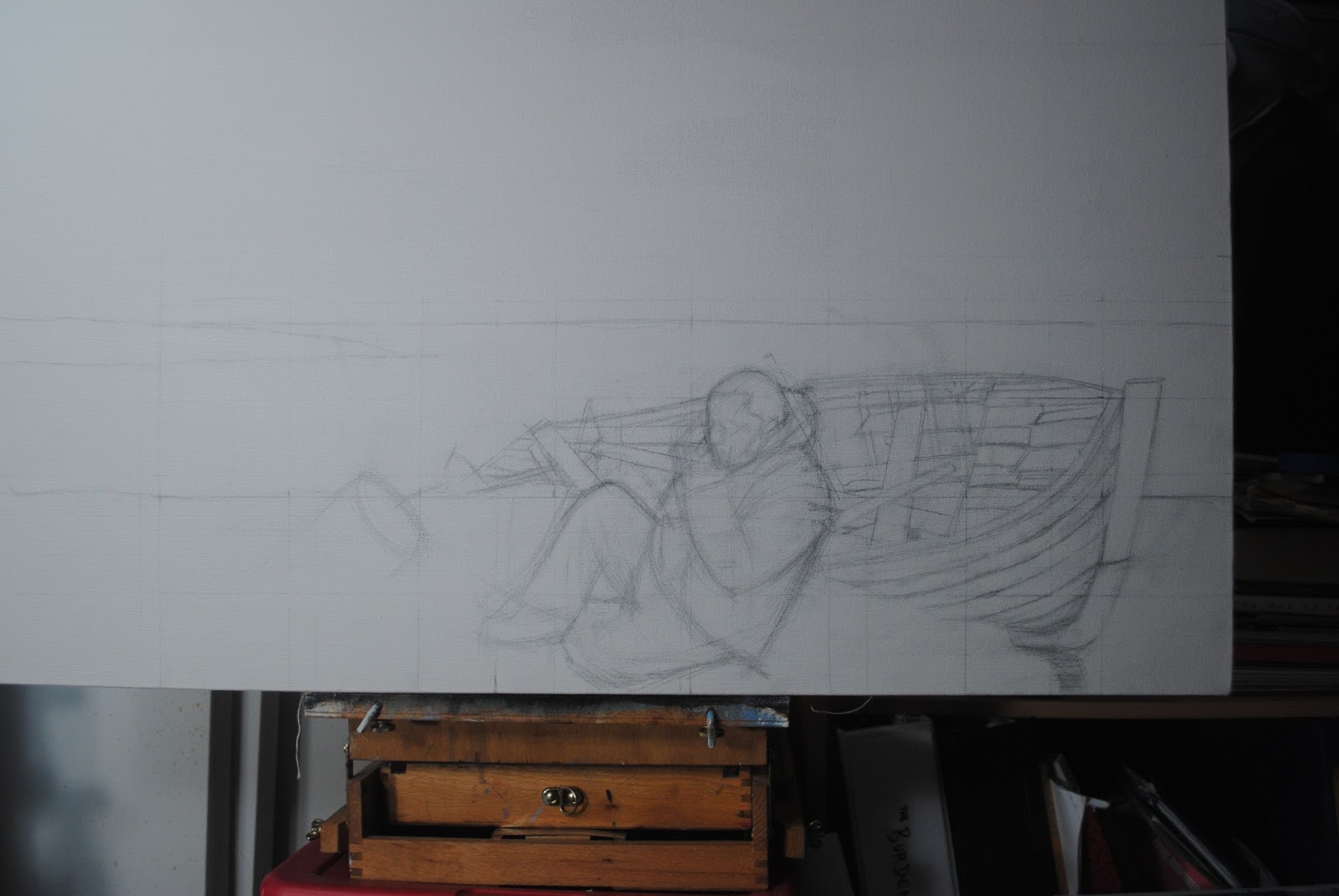
In this case, my idea was to paint two large canvases, one set above the other, one evoking the sky, the other Earth.  I wanted the two to remain separate because I enjoyed the idea of the two functioning as one piece and yet as separate.  I had been thinking about duality at the time, how the known and the unknown, the concrete and ethereal are eternally twinned and yet deeply divided from each other.  I might even say opposed to each other.  And I have to admit, as a human being living on earth I was feeling a bit of frustration at how oblivious nature (or heaven, the "other", the void, whatever you call it) can seem to our concerns.  Part of this thought was also inspired by a painting I had already finished.  It was a large rectangular piece containing nothing but clouds and blue sky.  I spent quite a bit of time on it but in the end, while I was struck by its expressiveness and its subjectivity, I was also struck by its apparent inhumanity.  It seemed empty and full at the same time.  I wanted more, a human element, something with which I could identify or channel myself through.  That was when I decided to rough in that second canvas below it, containing a man sitting by a broken-down boat on a field.  Perhaps by water.  I hadn't decided.  Anyway, I drew it up, worked out some compositional problems, and then went into sketeching the individual pieces in greater detail, always referring back to the thumbnail for composition.

Once I had reached a point where I felt I had enough of it realized, I drew a screen over my thumbnail and reproduced the thumbnail at a much larger scale.  I then got to work on filling in those details on the canvas...


At this point, I'm referring to lots of different photo references.  I prefer to use a variety, not just one, to help me patch together what I'm seeing in my head.  Straight reproduction annoys me but I do find gleaning fundamentals of proportion, texture, and shape from photo references are helpful in keeping me honest.  They're never a substitute for the real thing but oftentimes the real thing just ain't around.  Anyway, while I might call the live model the true star of any realist process, the imagination is ultimately the director, producer, and writer.  And so it was in this case.


Once I felt I had enough information to work with in paint, I put the finished cloud painting on top of this one and washed in some blue on the bottom half to match it.  


At this point, it's all improvisation and play.  I heard someone say once that, in painting, you have to build the stage before you can dance on it.  This is quite true in this case.  I had to build the canvas frame, stretch it, paint and sand about three layers of gesso on it, layout, sketch, compose, transfer, and finally lay in the base underpainting.  Finally, the spontaneity begins and I start to enjoy the unpredictability.  In this case, while I originally had thought the ground would lead down to a beach of sorts, I decided that a cliffside scene would do better.  I was delighted at how odd it might seem to have a boat at the top of a tall cliff, rather than at the bottom of it.  So I put in another cliff in the background to suggest that we were indeed fairly high above sea level.  I played around a bit with the colors in the foreground, keeping the contrast between ruddy earth tones and the greens and grays of the boat, unifying the two in the man sitting by the boat.  Here's the end result, which you can see a bigger shot of in my online gallery and personally at Cupcake Royale.


New Show at Cupcake Royale

If you happen to be in the Seattle area, please stop in to see my work at Cupcake Royale at the Alaska Junction in West Seattle.  A selection of new and old pieces will be on display there for the next two months so check it out and let me know what you think!